
Coastal Upwelling in the Northern South China Sea
There is a broad shelf region in the northern South China Sea (NSCS) off of the China coast, on which the 50-m isobath begins to diverge eastward from the shoreline east of the Pearl River Estuary. During summer, the southwesterly monsoon prevails in the SCS and a northeastward boundary current dominates the coastal circulation. Wyrtki (1961) first reported the coastal upwelling during the summer in the NSCS. The summer southwesterly wind is widely regarded as the main driving mechanism for coastal upwelling in the NSCS according to the classical Ekman theory (Hu et al., 2001; Hu and Wang, 2016; Li, 1993).
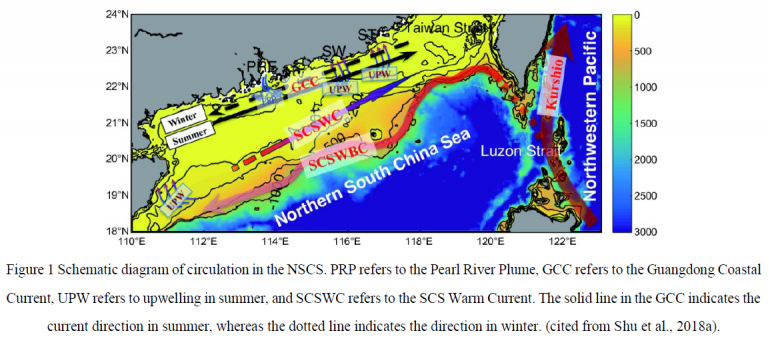
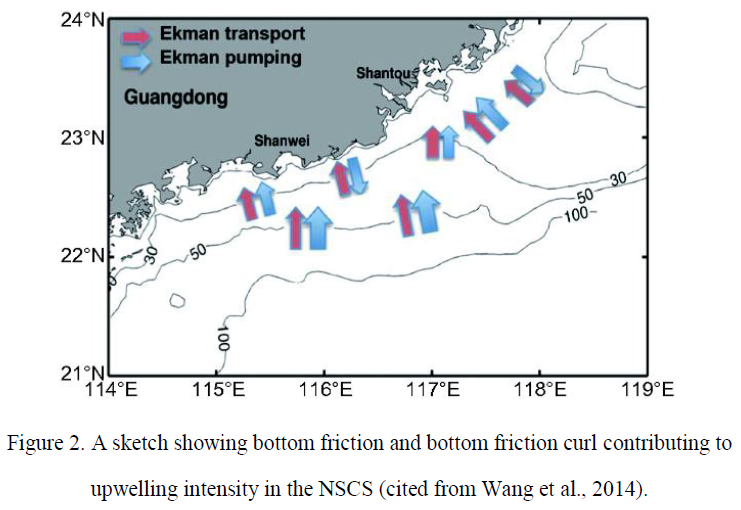
The spatial distribution of the NSCS coastal upwelling intensity is controlled by the orientation of the monsoon winds and the wide shelf topography (Gan et al., 2009; Shu et al., 2011; Su and Pohlmann, 2009). Gan et al. (2009) found that the cold, dense bottom water advecting from outer Shanwei outcrops near the shore of Shantou because of the alongshore gradient force induced by the alongshore topography and coastal line. Wang et al. (2014) further found that even without local upwelling-favorable wind forcing, the interaction between the northeastward coastal current and the widened shelf topography can also drive upwelling (termed topographically induced upwelling) because of the bottom Ekman transport and Ekman pumping generated by bottom friction and its curl.
The intraseasonal variability in upwelling intensity is closely correlated with the variation in alongshore wind (Gan et al., 2014; Wang et al., 2012). The southwestern summer monsoon in the NSCS presents substantial intraseasonal variation and is often associated with upwelling-unfavorable wind events. Using satellite and in situ data, Wang et al. (2012) confirmed that the upwelling intensity in the NSCS is closely related to variations in the wind field. They found that strong coastal upwelling mainly occurs between the Shanwei and Fujian coastal areas during prevailing southwesterly winds, whereas upwelling can still occur near Shantou during upwelling-unfavorable wind events because of a longer upwelling shutdown time scale in that area. Gan et al. (2014) studied the response of upwelling to variations in upwelling-favorable wind and upwelling-unfavorable wind in the NSCS. Their results showed that upwelling-favorable wind forcing is the main generation and maintenance mechanism of coastal upwelling in the NSCS, whereas the interaction between shelf current and topography is an important factor for upwelling persistence during periods of limited upwelling-favorable wind.
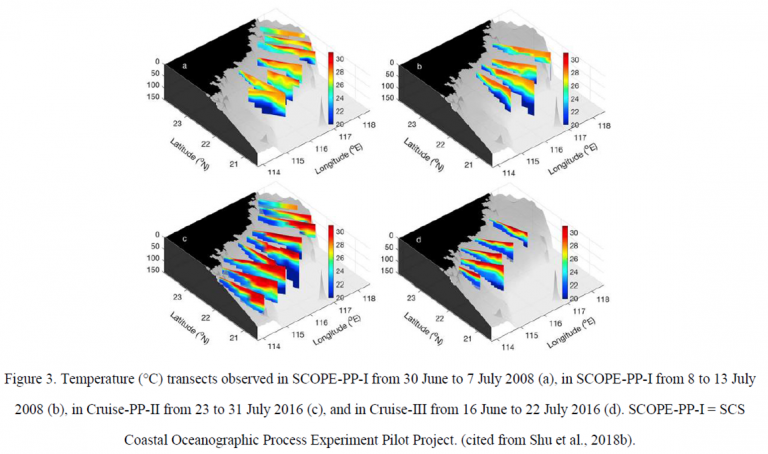
The upwelling in the NSCS has strong interannual variability (Hong and Li, 1991). Jing et al. (2011) found that upwelling was anomalously enhanced during the summer of 1998 when the local southwesterly wind was 2 times stronger than normal years. Their analysis showed that the anticyclonic atmospheric circulation anomaly associated with the 1997–1998 El Niño in the SCS and western Pacific enhanced the summer southwesterly wind in the NSCS, which resulted in stronger upwelling. Based on in situ data, Shu et al. (2018b) found that the upwelling was much stronger during 2016 than during 2008, though the local wind was more favorable to upwelling during 2008, which indicated that local wind is not the sole factor controlling the interannual variability in upwelling intensity in the NSCS (Figure. 3). Their further studies showed that, beside the locale wind, the interannual variability in basin-scale circulation could also contribute to the interannual variability in coastal upwelling intensity due to the topographically induced upwelling in the NSCS.
References
Gan, J. P., A. Cheung, X. G. Guo, and L. Li (2009), Intensified upwelling over a widened shelf in the northeastern South China Sea, J. Geophys. Res., 114, C09019, doi:10.1029/2007JC004660.
Gan, J., J.Wang, L. Liang, L. Li, X. Guo, 2014. A modeling study of the formation, maintenance, and relaxation of upwelling circulation on the Northeastern South China Sea shelf. Deep-Sea Res II, 117: 41–52.
Hong, Q., and L. Li, 1991. A study of upwelling over continental shelf off eastern Guangdong. Journal of Oceanography in Taiwan Strait. 10(3): 272-277 (in Chinese with English abstract).
Hu, J., Kawamura H., Hong H.S., et al., 2001. Hydrographic and satellite observations of summertime upwelling in the Taiwan Strait, A preliminary description, Terr. Atmos. Ocean. Sci., 12: 415-430.
Hu, J., X. Wang, 2016. Progress on upwelling studies in the China Seas. Rev Geophys, 54(3): 653–673.
Jing, Z., Y. Qi, and Y. Du, 2011. Upwelling in the continental shelf of northern South China Sea associated with 1997–1998 El Ni~no, J. Geophys. Res., 116, C02033, doi:10.1029/2010JC006598.
Shu, Y., D. Wang, J. Zhu, S. Peng, 2011. The 4-D structure of upwelling and Pearl River plume in the northern South China Sea during summer 2008 revealed by a data assimilation model. Ocean Model., 36: 228–241.
Shu, Y., Q. Wang, T. Zu, 2018a. Progress on shelf and slope circulation in the northern South China Sea. Science China Earth Sciences, 61: 560-571.
Shu Y., D. Wang, M. Feng, B. Geng, J. Chen, J. Yao, Q. Xie, and Q.-Y. Liu, 2018b. The Contribution of Local Wind and Ocean Circulation to the Interannual Variability in Coastal Upwelling Intensity in the Northern South China Sea. Journal of Geophysical Research: Oceans, 123: 6766–6778. DOI:10.1029/2018JC014223
Su, J., T. Pohlmann, 2009. Wind and topography influence on an upwelling system at the eastern Hainan coast. J Geophys Res, 114: C06017.
Wang, D., W. Zhuang, S. P. Xie, J. Hu, Y. Shu, and R. Wu, 2012. Coastal upwelling in summer 2000 in the northeastern South China Sea, J. Geophys. Res., 117, C04009, doi:10.1029/2011JC007465.
Wang, D., Y. Shu, H. Xue, J. Hu, W. Zhuang, T. Zu, J. Xu, 2014. Relative contributions of local wind and topography to the coastal upwelling in the northern South China Sea. J Geophys Res, 119(4): 2550–2567.
Wyrtki, K., 1961. Physical oceanography of the southeast Asian waters: Scientific results of marine investigations of the South China Sea and the Gulf of Thailand 1959–1961, NAGA Rep. 2, 195 pp., Scripps Inst. of Oceanogr., La Jolla, Calif.