
Upwelling Along the East Coast of Peninsular Malaysia
Background
Upwelling is an oceanographic process that has a major impact on primary productivity as it replenishes nutrient-depleted surface water for phytoplankton growth. Although the upwelling has been extensively studied, but this is not the case for the smaller scale upwelling area located along east of Peninsular Malaysia (ECPM). The upwelling along the ECPM was only discovered in the 2010s, which is far behind other upwelling areas, so lots of important features are still ambiguous. Intensive studies should therefore be conducted in order to enhance current knowledge and to acquire new information on the upwelling process along the ECPM.
Previous Studies
The upwelling along the ECPM was unintentionally discovered from the cruise surveys conducted during the southwest monsoon where a classical sign of upwelling, i.e. onshore thermohaline shoaling towards the coast and surface was observed from the cross-sectional transects (Roseli et al., 2015). The implementation of satellite-derived sea surface temperature (SST) revealed much more detail of this feature, particularly in terms of its temporal and spatial scales (Akhir et al., 2015; Kok et al., 2017, 2015). The upwelling was found to occur along the ECPM from its southern tips to about 5 ˚N, which is represented by an elongated band of cooler SST which was about 0.5 ˚C cooler than the offshore waters during the time between June and September during the southwest monsoon (Figure 1). However, this band of cooler SST was found not only spawned by upwelling alone, where the cooler water advection from the Java Sea was also responsible for its formation (Kok et al., 2015, 2019).
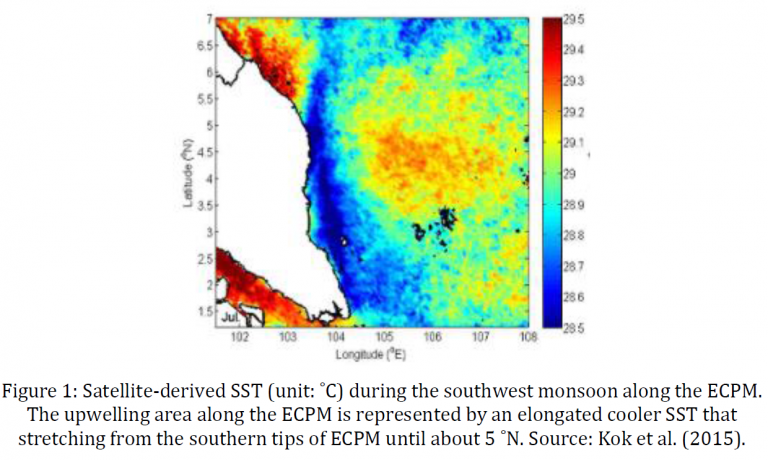
As regards the upwelling factor, previous studies indicated that both wind-driven upwelling processes, i.e. Ekman transport and Ekman pumping lead significantly to the upwelling along the ECPM (Akhir et al., 2015; Daryabor et al., 2015; Kok et al., 2015). However, by integrating Ekman pumping out to a distance where the positive wind stress curl remains, it was suggested that Ekman pumping was more critical than Ekman transport in engendering upwelling along the ECPM (Kok et al., 2017).
Research Updates
Recently, we manage to simulate upwelling features along the ECPM by using a well calibrated free-surface, split-explicit and terrain-following coordinate regional ocean model, i.e. Regional Ocean Modelling System (ROMS). A series of numerical experiments were carried out on the basis of simulation to investigate the physical processes that could multiformly drive upwelling along the ECPM. In contrast to the previous finding, the experimental results suggested that Ekman transport played a direct and predominant role in the upwelling along the PMEC rather than the Ekman pumping. Apart from this process, the advection of low salinity water from the Java Sea was found to play a significant role in engendering upwelling along the PMEC. This advection of fresher water resulted in the formation of a density front in the upper inshore region, generating baroclinic pressure gradient force across the front, which prompted upwelling as a branch of cross-frontal secondary circulation. Nonetheless, its influence is smaller than that of Ekman transport.
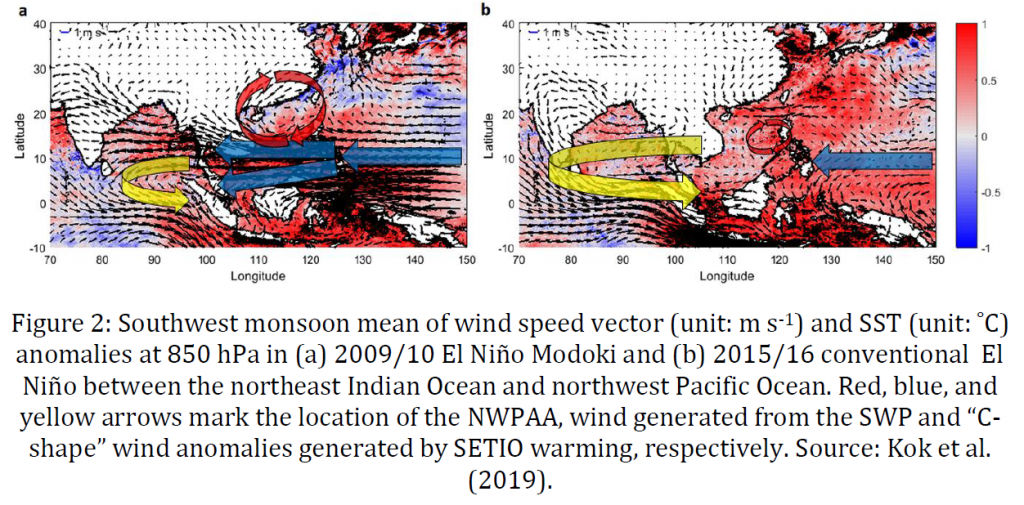
In addition, a study has been carried out to investigate the interannual variability of upwelling along the EPCM. The upwelling along the PMEC displayed interannual variability that is closely associated with the delayed El Niño Southern Oscillation (ENSO) effect. Our analysis focusing on the two El Niños varieties, i.e. 2009/10 El Niño and 2015/16 El Niño suggested that intense northwest Pacific anticyclone anomaly and the occurrence of the northerly wind anomalies from the subtropical western Pacific in 2010 weakened the upwelling along the ECPM. While in 2016, the existence of the “C-shape” wind anomalies generated by the warming of the southeast tropical Indian Ocean weakened the upwelling the upwelling along the ECPM (Kok et al., 2019) (Figure 2).
Ongoing Study/Future Planning
The current upwelling study focuses on the impact of climate change on upwelling along the ECPM. This study is conducted by using model data obtained from the Coordinated Regional Climate Downscaling Experiment-South East Asia (CORDEX-SEA). The study will observe two future climate scenario which is RCP4.5 and RCP8.5. Furthermore, the study will be divided into three period of study, i.e. early century (2010-2040), mid-century (2041-2070) and late century (2071-2100) in order to observe how upwelling change as time passed.
References
Akhir, M.F., Daryabor, F., Husain, M.L., Tangang, F., Qiao, F., 2015. Evidence of upwelling along Peninsular Malaysia during southwest monsoon. Open J. Mar. Sci. 5, 273–279. https://doi.org/10.4236/ojms.2015.53022
Daryabor, F., Samah, A.A., Ooi, S.H., 2015. Dynamical structure of the sea off the east coast of Peninsular Malaysia. Ocean Dyn. 65, 93–106. https://doi.org/10.1007/s10236-014-0787-5
Kok, P.H., Akhir, M.F., Qiao, F., 2019. Distinctive characteristics of upwelling along the Peninsular Malaysia’s east coast during 2009/10 and 2015/16 El Niños. Cont. Shelf Res. 184, 10–20. https://doi.org/10.1016/j.csr.2019.07.004
Kok, P.H., Akhir, M.F., Tangang, F.T., 2015. Thermal frontal zone along the east coast of Peninsular Malaysia. Cont. Shelf Res. 110, 1–15. https://doi.org/10.1016/j.csr.2015.09.010
Kok, P.H., Akhir, M.F.M., Tangang, F., Husain, M.L., 2017. Spatiotemporal trends in the southwest monsoon wind-driven upwelling in the southwestern part of the South China Sea. PLoS One 12. https://doi.org/10.1371/journal.pone.0171979
Roseli, N.H., Akhir, M.F., Husain, M.L., Tangang, F., Ali, A., 2015. Water mass characteristics and stratification at the shallow Sunda Shelf of southern South China Sea. Open J. Mar. Sci. 5, 455–467. https://doi.org/10.4236/ojms.2015.54036